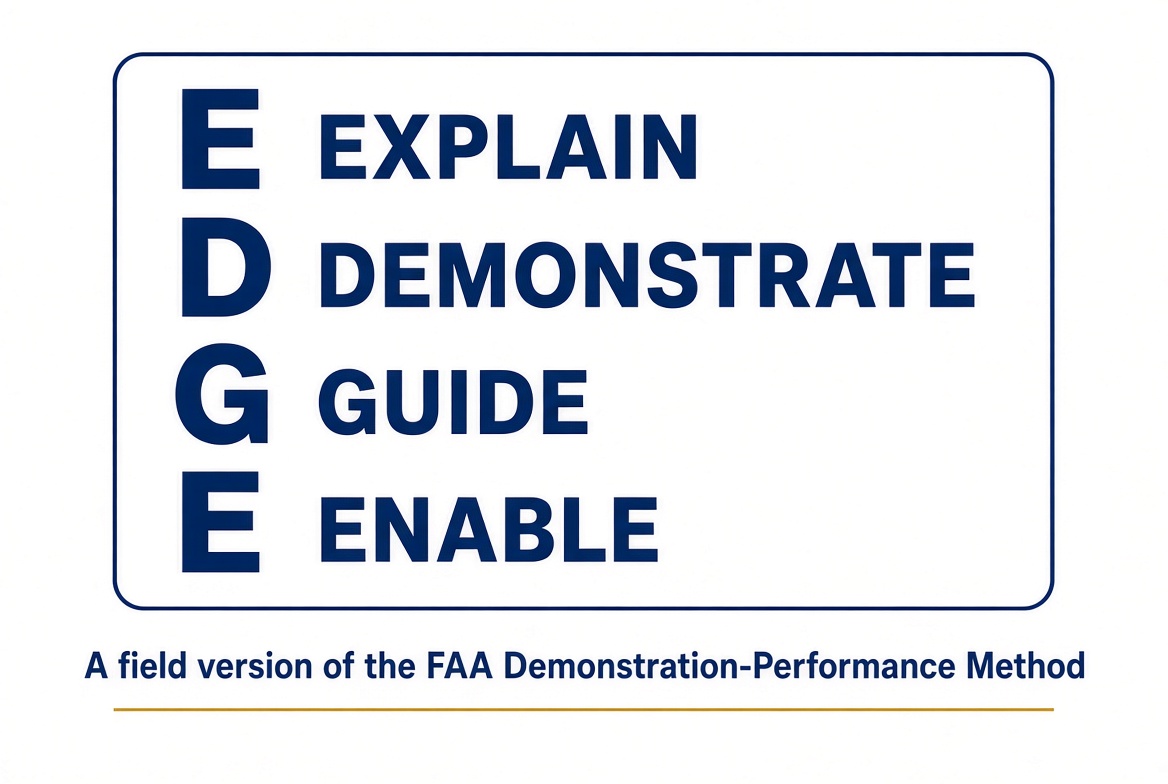
Every CFI already has an instructional method drilled into them from ground school: the FAA’s demonstration-performance method. It’s in the Aviation Instructor’s Handbook, it’s on the FOI knowledge test, and most of us can recite its shape from memory — explain it, demonstrate it, let the student try it, evaluate how they did. What fewer CFIs know is that Scouting America built something almost identical, decades of trial-and-error deep into youth leadership training, and gave it a name simple enough to actually use mid-lesson: EDGE — Explain, Demonstrate, Guide, Enable.
The overlap isn’t a coincidence so much as a convergence. Both frameworks are trying to solve the same problem: how do you move a person from zero knowledge of a skill to independent, reliable execution of it, without skipping a step that their performance failing later?
The FAA’s demonstration-performance method runs in four phases: explanation, demonstration, student performance paired with instructor supervision, and evaluation. In the explanation phase, the instructor describes the skill, its purpose, and the standard the student will eventually be measured against. In demonstration, the instructor performs it cleanly and correctly — no narrating mistakes, no “let me show you what not to do,” because first impressions are sticky (the handbook calls this the law of primacy, and it’s brutally accurate: students remember what they see first, correct or not). Then comes performance and supervision, which the FAA treats as one concurrent phase — the student flies it while the instructor coaches in real time. Finally, evaluation: did they meet the standard, and what does the next lesson need to fix.
The EDGE model used by Scouting America (formely the Boy Scouts of America) maps onto this almost exactly for its first half. Explain and Explanation are the same move. Demonstrate and Demonstration are the same move, down to the same caution about keeping it clean rather than editorializing. Where the two frameworks start to diverge — and where EDGE actually earns its keep for flight instructors — is in what happens after the student takes the controls.
The FAA’s method folds “student performance” and “instructor supervision” into a single phase, which is accurate but a little slippery in practice. It’s easy to read “supervision” as “correction,” and easy for a CFI to stay in correction mode for lesson after lesson without ever explicitly deciding to stop. EDGE forces the decision by splitting that phase into two named, sequential steps: Guide, where you’re actively coaching and correcting in real time, and Enable, where you deliberately go quiet and let the student fly it alone. That’s not a cosmetic difference. Ask most flight instructors when a student “should” be flying a maneuver unsupervised and you’ll get a shrug — it happens whenever it happens. Ask when Guide ends and Enable begins, and now there’s a specific, nameable moment: the point where you tell the student “I’m not saying anything unless it’s a safety issue,” and then actually hold to it.
The other place EDGE pulls ahead is in what “evaluation” actually means. The FAA’s fourth phase asks whether the student met the standard. EDGE’s Enable step asks something slightly bigger: does the skill hold up somewhere new? A student who can nail short-field landings at the home airport, in calm wind, on the runway they’ve used forty times, hasn’t necessarily learned short-field landings — they may have learned that runway. Enable pushes the CFI to test the maneuver in a different context: a new airport, a crosswind, a different pattern entry. That’s the difference between a skill and a memorized routine, and it’s exactly the kind of thing a designated pilot examiner is going to probe for on a checkride whether or not you trained for it deliberately.
None of this means CFIs should throw out what they learned for the FOI test. EDGE and the demonstration-performance method aren’t competitors — EDGE is closer to a more granular, more nameable version of the same idea, with better handles on the part most instructors gloss over. If you already teach using explanation, demonstration, and supervised practice, you’re most of the way to EDGE already. The value in adopting the vocabulary isn’t novelty; it’s precision. “Guide” and “Enable” give you two distinct mental checkpoints instead of one blurry “practice” phase, which makes it much easier to notice when you’re still hovering out of habit rather than because the student actually needs it — a trap that’s easy to fall into and hard to see from the inside.
There’s also a quieter benefit for instructor development. New CFIs are often taught the demonstration-performance method as an abstraction to be memorized for a test, not a habit to be practiced in the airplane. EDGE, borrowed from an organization whose entire existence depends on teenagers successfully teaching skills to other teenagers, comes with a built-in bias toward practicality: it’s designed to be usable by a non-expert teaching in real time, which is closer to what a low-time CFI actually is than the FAA handbook’s prose sometimes assumes. If the demonstration-performance method is the theory, EDGE is a usable field version of the same theory — one more CFI can actually run, lesson after lesson, without losing track of which step they’re on.
Give it a try as you provide instruction in the aviation field. Take the old method from the FAA and upgrade it a little bit to what the Scouts have developed, the EDGE method.
Want to learn more about applying the EDGE method in teaching aviation students?
Click here or the graphic below.
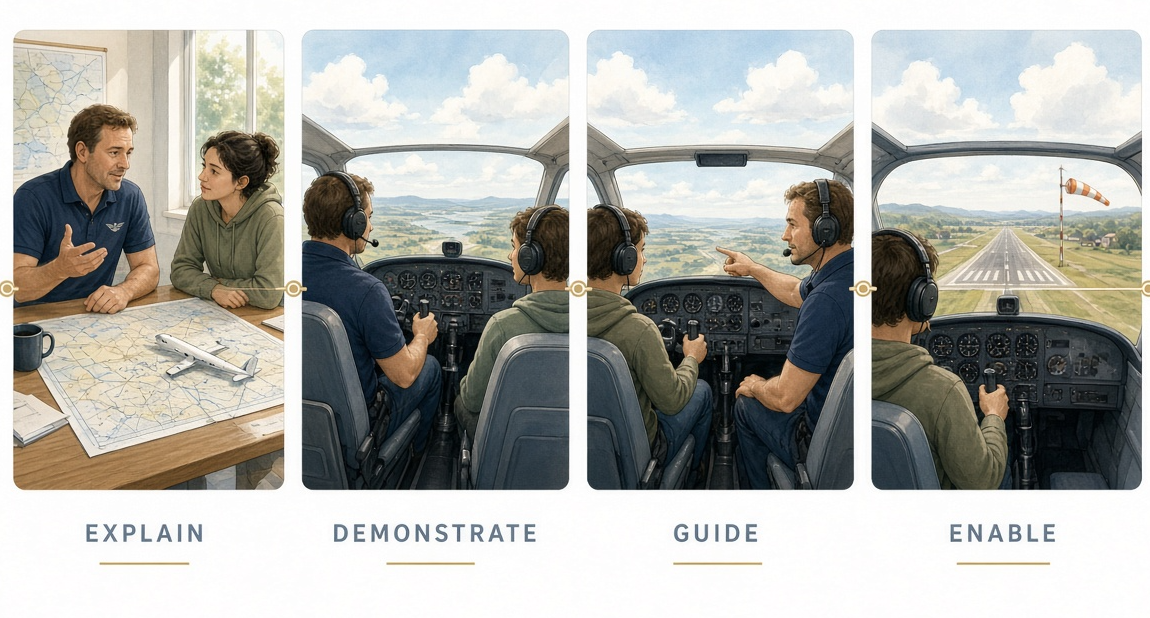
Excellent! Many instructors fail between the Guide and the Enable phases. A clear delineation is crucial to building student confidence. Another critical element during the Guide phase is the Instructor’s ability to build in progressions of learning, breaking the skill or maneuver into small, simple steps that can be practiced and mastered then combined into the final version. Unfortunately this is poorly understood and not really emphasized in FAA instructional materials.