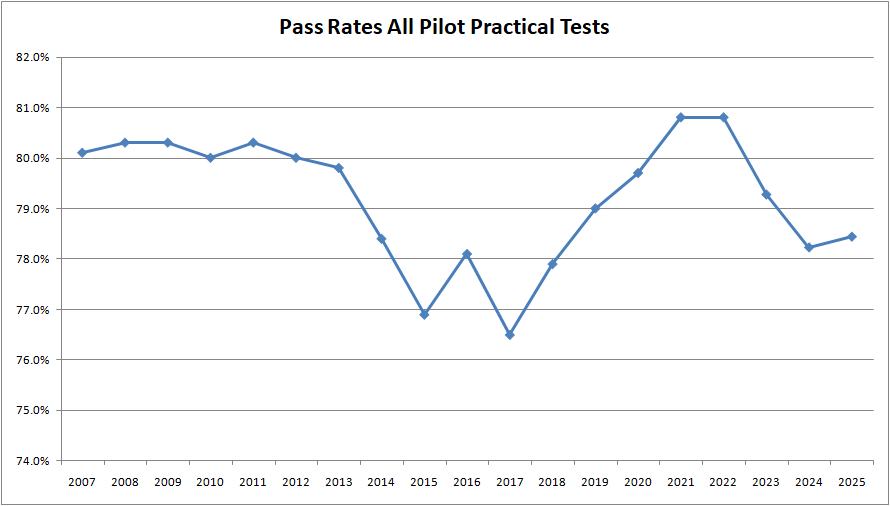
As an overall trend, pass rates on practical tests went up slightly in 2025, compared to 2024. You can see that broad trend in the following chart.
But that’s a lot of different kinds of tests. When it comes to the pilot pipeline, I like to break it down more in terms of some of the common testing events. We can see the pass rates on the Private Pilot, the Commercial Pilot, the CFI, and the ATP practical tests.
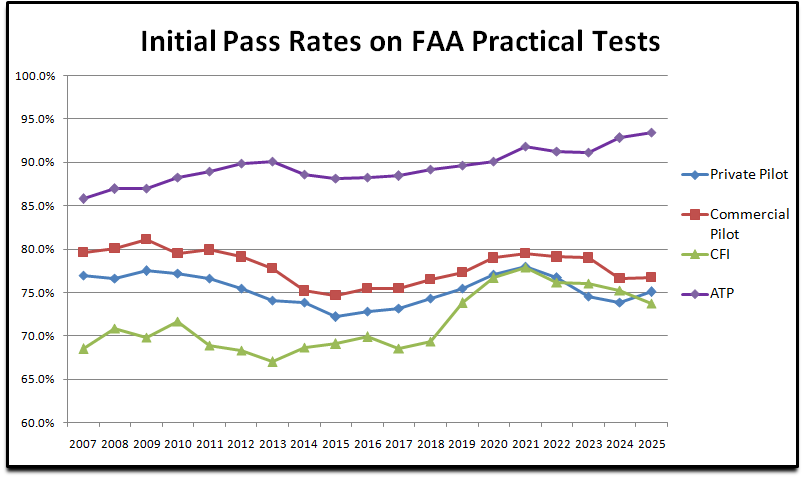
We saw positive trends on the Private Pilot, Commercial Pilot, and ATP practical test events. Not signficant changes in the pass rates, but at least not going down. The CFI was the one that continued to show a trend downward, though.
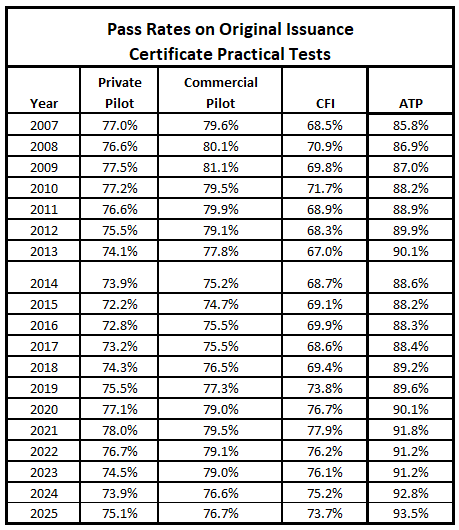
We can see this more clearly in the chart to the right here. Looking at the data, we can see that the CFI practical test pass rate peaked in 2021 and has been dropping over the past few years.
When it comes to sheer numbers, what this means is that, in one context, it means that if we consider that DPEs conducted 14,077 practical tests for CFI applicants (passes and failures included), that drop in pass rate from 75.2% to 73.7% means that DPEs had to do an additional 280 retest practical tests. That is the equivalent of a fully active high-activity DPE. The point I am making here is that pass rates affect lots of things, including DPE availability.
It also begs the question, if we have decreasing rates of passing for CFI candidates, is that an indicator of their overall knowledge and quality of those CFIs and the next generations of pilots they are going to train?
Pass rates help us understand the number of tests required in the system, are some metric on the quality of training happening, and help us see any trends in the success rates of our pilots in training who are taking tests with DPEs or FAA inspectors.
Oh, and one thing to keep in mind on these reported pass rates. These include the RETESTS also. These are not just initial attempts. So we are bringing our pass rate up a little through the weighting of the retest in the overall test numbers.(the model is below that I used), I came up with some estimated first time pass rates on these certificates
With a little creative modeling, considering how many tests were give by DPEs, how many certificates were issued, and this pass rate data, I have estimated that the real FIRST TIME pass rates this past year are probably be about as follows:
Estimated 2025 First Time Pass Rate
Private Pilot – 66-68%
Comeercial Pilot – 69-71%
CFI – 66-68%
I will keep tracking these trends and give you more data next, about the same time when the 2026 data is out!
*Note: These pass rates do not include any certification events that take place under self-examining events (141 training programs with self-examining authority).
——————————————————————–
The model I used to estimate the first-time pass rate:
Assume:
- Every applicant eventually passes (realistic for motivated students; dropouts are ignored).
- Failures lead to exactly one retest that succeeds (the “original + subsequent retest” scenario the query describes; no triple+ attempts, yes there would actually be a few of these, but they are typically a small percentage).
- Let p = overall pass rate = passes / total tests.
- Let m = average attempts per successful applicant = 1/p.
- Then: f₁ = 2 − m = 2 − 1/p (derived from: first-attempt passes = f₁ × N; retests = (1 − f₁) × N; total tests = N(2 − f₁)).